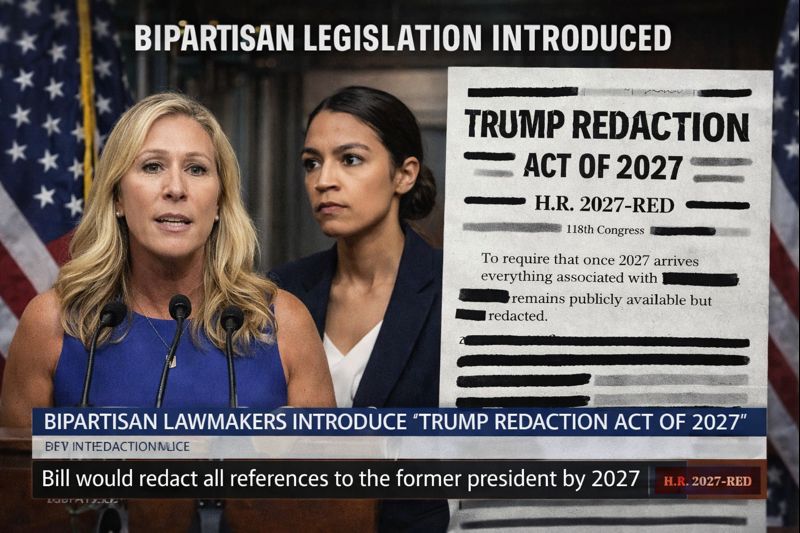
Bipartisan Lawmakers Introduce “Trump Redaction Act of 2027”
WASHINGTON (Debate Junkie) — A bipartisan pair of lawmakers on Thursday introduced legislation that would require the standardized redaction of former President Donald Trump’s name from public records and federally branded items beginning in 2027, citing “historical clarity” and “an excessive national Sharpie deficit.”
The bill, titled the Trump Redaction Act of 2027 (H.R. 2027-RED), is co-sponsored by Reps. Marjorie Taylor Greene and Alexandria Ocasio-Cortez, marking one of the rare moments of agreement between the two lawmakers.
According to a summary released by the sponsors, the bill would take effect in 2027 to align with the anticipated transition following the 2026 elections, when control of Congress is expected to shift and the MAGA movement is projected to be replaced “by something less slogan-based.”
“This isn’t woke erasure,” Greene said during a brief appearance before the House Oversight Committee. “Redaction keeps the record public. It just removes distractions.”
Ocasio-Cortez framed the bill as educational.
“Redacted text forces people to ask questions,” she said. “That’s civics. If future Americans see page after page of black bars, they’ll want to know why. That’s the point.”
Committee Hearing Highlights
During testimony, lawmakers emphasized that the bill would preserve all Trump-era documents, signage, and branded materials while obscuring the former president’s name with standardized black redactions.
“Innocent people don’t usually require this much ink,” one committee staffer noted, prompting a brief pause in the hearing.
When asked whether the legislation was politically motivated, Greene responded, “If politics were involved, this would be way messier.”
What the Bill Covers
Under H.R. 2027-RED, redaction would apply to:
• Federal documents and reports • Buildings and facilities bearing Trump’s name • Policies, slogans, and merchandise associated with his administration • Archived references to “MAGA,” which would be reclassified under Historical Political Movements
The bill does not require destruction of any materials, only modification.
Reaction
Republican leadership criticized the proposal as symbolic, while several members privately asked whether it could apply retroactively to social media posts, and that their comments be redacted.
Democratic leaders praised the bill’s “contextual approach,” though budget analysts raised concerns about Sharpie procurement.
A statement released by Trump’s campaign called the proposal “illegal, unconstitutional, and very unfair.”
The statement was released in full. Several portions were redacted for consistency.